Showing Up

I take vitamins. I have for years. Whether or not they’re helpful, I don’t know. I think they are. Either way, I take them because of habit, along with an unspoken hope to stave off decline. Hope and habit, I suppose, outweigh my skepticism.

Each morning, I rattle and shake the pills from my dispenser like dice in a gambler’s palm, casting my lot with D3, E, and others I hope will maintain my joints and back. There’s a strange comfort in the ritual—a brief moment every morning of feeling like I’ve done something to tip the scales in my favor. After all, I’m getting older, and nowadays, I’m less concerned about being what I once was as an athlete and more interested in picking up my grandson, Preston, when he reaches out to me.

Admittedly, I sometimes wonder if it’s all just a polite nod to the illusion of betterment. Maybe. But in a world that already feels incredibly out of balance, the smallest rituals can be the most stabilizing. And for me, that’s reason enough to continue.

A few weeks ago, Jennifer and I were remembering when we first met. After that brief conversation, I found myself drifting into earlier memories, years before Jennifer. Back then, I was a determined guy who didn’t like to lose. I’m still that way today, but nowhere near the level of my youth. Looking back at my late teens and early twenties, I see now that much of what I claimed to know was really just a thick confidence borrowed from youthfulness. Life seems to thin out over time—not just in muscle mass or bone density, but in what I actually know. There’s truth in the saying: the more you know, the more you realize just how much you don’t know. I was so sure about certain things that I ended up saying or doing things I probably wouldn’t say or do today. In truth, I didn’t fully understand the situation, but I acted anyway, believing I did.

Thankfully, most things worked out. God certainly used my youthful zeal for my betterment. That said, I lean less on determination these days and more on steadiness. Like my vitamin regimen, I’ve exchanged the need for proof with the simple desire to keep showing up every day.

Determination has given way to commitment.

You’d be surprised how much happier a person can be when he’s less interested in the next big accomplishment and more committed to the long game of where he is right now. When it comes to life in the Church—life as a pastor—that’s a better posture anyway. A pastor’s life isn’t defined by conquest beyond his congregation’s borders. Sometimes that’s necessary. But most of the time, it’s about continuity—holding to faithfulness and preserving a congregation’s Christian identity. Much of what we do is simply hanging in there and not giving up. It’s preaching and teaching today, trusting that it will take root and grow tomorrow.

At the heart of it, I suppose what I’m really thinking about and pointing toward this morning is faithfulness. Saint Paul wrote, “It is required of stewards that they be found faithful” (1 Corinthians 4:2). Paul already knows how a developed knowledge of God’s Word and sound doctrine is essential. But here, he implies that no small part of the task itself is faithful stewardship with what He’s given and where He’s situated you to use what He’s given.

No small part of the task is showing up.

Showing up has taught me some things. For one, I’ve learned that the truly sacred things in life are the ordinary, everyday things. I’ve also learned that when they’re gone, they’re missed more than any titles or trophies ever achieved along the way. The most meaningful moments in my life rarely arrive with fanfare. They come quietly—and they take many forms. The most recent was a child in our school who asked me a theological question that stopped me in my tracks. I hadn’t thought about the topic that way before, and with the child’s help, I could see the world a little differently. Truthfully, the same thing happens more often than not in most casual conversations with young and old here at Our Savior. But the point is that such moments don’t happen through force—they happen through repetition, patience, and the long, slow process of showing up.

So yes, I show up to take my vitamins. But I also show up each week with an eNews message. I show up in the pulpit with a sermon. I show up prepared for Bible study or religion class. I show up when I’m called to someone’s hospital room at two o’clock in the morning. I show up when my children need me. (They’ll tell you I show up even when they don’t.) I show up for meetings. I show up to hear confessions that break my heart. I show up when a couple’s marriage is struggling. I show up to pray every morning for the congregation God has called me to serve.

I show up for myself, too. For one, writing is my thing. It’s therapeutic. But I also show up in other ways: taking a minute to stretch on the closet floor in the morning, gulping down a handful of vitamins, doing a few pullups or planks when I get a chance, walking on the treadmill—not because I’m chasing youth, but because I’m caring for what remains.

That’s what life looks like for me now. It’s certainly not complacency. But it is less about accomplishment and more about steadiness. And just so you know, I think there’s a quiet kind of victory in staying steady and persistent—to be available to hold Preston when he wants to be held, to be present for those quietly arriving moments.

After I’m gone, for whoever chooses to remember me, I don’t want the strength of my life measured by accomplishment. I want it measured by faithfulness. That’s the standard I’m aiming for—not brilliance, not acclaim, not even success as the world defines it. Just faithfulness to my Lord and to the people among whom He’s placed me. Day in and day out, it was just as habitual to do what needed to be done among them as it was to take my vitamins. It’s really as simple—and as profound—as that.

God’s Word is not a Talisman

It didn’t take long for me to discover what I wanted to write about this morning. The image I’ve shared here (with the strikethrough I added, affirming my disgust) was all the inspiration I needed.

Now, before I say what’s on my mind, just know that if you purchased the item advertised, I’m not condemning you. Advertising is designed to rope us into doing things we might not normally do. However, I suppose if you succumbed to this particular advertisement, then I am concerned. With very little wiggle room for alternate interpretation, the ad implies something deeply theological, and it isn’t good.

In short, the advertisement’s premise is “How to get closer to Christ.” Next, it gives the following three steps for accomplishing this:

Take a tiny slate.
Etch the Holy Bible on it.
Wear it on jewelry.

So, plainly, a way to draw nearer to the Savior of the world—to actually be closer to Him—is to miniaturize the entirety of His written Word to a nano-size document unreadable by any human being, and then hang the document around your neck as a trinket. Therefore, by wearing the necklace, you are closer to Christ, and He is closer to you.

What’s the implied theology here? Well, before I go any further, let me first deal with what I expect will be a knee-jerk concern from readers wondering how this might be different from wearing a cross or crucifix as jewelry.

For starters, the Christian Church has long employed visible symbols—crosses, crucifixes, stained glass, icons. Lots of critics like to take aim at these things, suggesting the Church employs them as magical objects. I suppose some do. That’s unfortunate. However, genuine confessional Christianity doesn’t do this—and never did.

A crucifix, for example, places before our eyes the very heart of our faith: Christ crucified for sinners. It certainly doesn’t suggest that Jesus is somehow trapped in its wood or metal, or that the closer you are to it physically, the closer you are to Him. Instead, it visually echoes what can only be sourced from God’s Word: “We preach Christ crucified” (1 Corinthians 1:23). Even better, it demonstrates a completely different trajectory of approach, which is that “while we were still sinners, Christ died for us” (Romans 5:8). This is say that while our sinful nature would have nothing to do with God, He reached to us, giving Himself in the most comprehensive way. With these things in mind, a crucifix is a devotional aid that directs the senses to faith’s genuine object, Christ, and all that His person and work entail.

The advertised pendant, however, claims to contain the Bible, yet it’s completely undecipherable. You can’t see a chapter, a verse, not even a letter. It has no visual function, no teaching capacity, no communicative power. At best, it gestures vaguely at the idea of God’s Word. But only the wearer knows that—sort of. Not even they can read it. A crucifix, by contrast, is visible. A child can look at it and ask, “Who is that?” The one wearing it now has an opportunity to share the message behind the theological cue, which is the powerful Gospel message that saves (Romans 1:16).

The trinket in question? It invites no such conversation. It says nothing and teaches nothing. More to the point, it falls flat because of why it’s being sold—which is not complicated. The company wants you to believe that by buying and wearing this necklace, you will be closer to Jesus. That’s not the same as stained glass in a church. That’s not the same as a portrait of Christ in your home. That’s not even close to the purpose of a cross or a crucifix.

The consequences of believing and acting on this advertisement aren’t small. At a minimum, the company is selling talismans—the idea that proximity to God’s Word, rather than receiving it, is sufficient for faith. That’s not Christianity. Genuine Christianity knows how closeness with God is achieved. Ultimately, He comes to us in Christ, who is the Word made flesh (John 1:14). Indeed, He comes, not micro-etched on a pendant in talismanic fashion, but through the verbal and visible means of His Word He established; where His Word is read, proclaimed, preached, and taught; in Baptism, where water and Word unite to bring forgiveness and new life; the Lord’s Supper, where bread and wine are His body and blood, given for you.

Conversely, this pendant nonsense is little more than a devotional gimmick being sold in the marketplace of false teaching. It’s the kind of shallow spirituality that resulted in Jesus turning over tables (Matthew 21:12-13) and rebuking church leaders (Matthew 23:25-27).

I sometimes wonder how things like this gain traction. I suppose it’s because the ad uses Christian-like language and images, which makes it sound harmless, maybe even holy. But the message is upside down. Unfortunately, that’s entirely possible in a culture and world brimming with churches plagued by Christian illiteracy. This ad didn’t appear in a vacuum. It thrives in places where spiritual depth is replaced by shallow sentimentality. That someone thought this ad would work (and probably has metrics saying it does) is a sad commentary on what people think Christianity is. It also testifies to a generation raised on inspirational memes instead of catechesis. It signals a Christian faith that’s been gutted—hollowed out by unchecked religiosity peddling subjective emotion over objective doctrine.

Again, if you bought the pendant because you thought that by doing so you’d be closer to Jesus, I’m sorry. I’m not sorry if my words have offended you. I’m sorry that you didn’t know any better. I’m sorry that somewhere along the line, someone convinced you—or failed to love you enough—to correct the faulty notion that closeness to Christ could be achieved through anything other than the means He Himself instituted. I feel terrible that marketing has become so indistinguishable from ministry in our culture that it’s hard to tell the difference between a product pitch and a proclamation of truth, resulting in people spending their money on something that will not get them where they want to go.

But even as I’m sad about these things, I’m also hopeful. Because now you know that Jesus is not found in a pendant, no matter how cleverly it’s designed. He’s found where He promised to locate Himself: His verbal and visible Word, the Means of Grace. These means aren’t slick. If anything, they’re so mundane they’re unmarketable. Still, they are eternally powerful. And they’re yours, not by purchasing power, but because the God you could never with all your mortal intellect and strength draw near to loved you enough to draw near to you.

The Formula

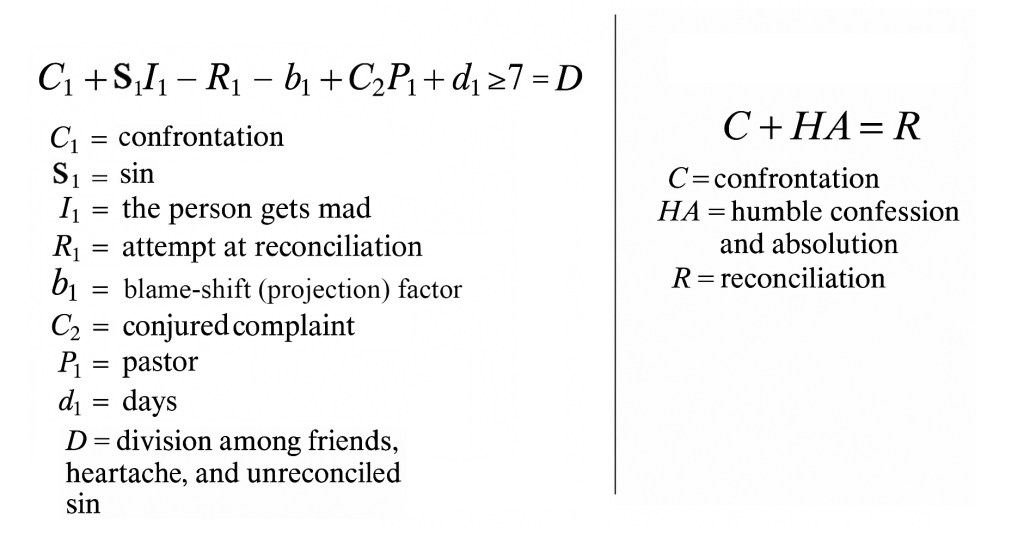
I should let you in on a little secret. It’s one that I shared with the adult Bible study group here at Our Savior last week. Essentially, it’s a formula of sorts that plays itself out in congregations fairly regularly. Here’s how it usually goes.

A troubling situation arises, and the pastor must address it—usually by speaking directly with the person at the center of the issue. He approaches the conversation with a spirit of reconciliation, aiming to restore peace. But no matter how gentle the pastor’s approach, the individual takes offense, receiving the pastor as a cruel accuser. Days pass (typically about a week, because anything sooner would be suspicious), and the pastor gets a message. This time, the grievance is reversed: the person has discovered an unrelated reason to be angry at the pastor for something he said or did. The pastor must shift his posture, now seeking to reconcile a situation in which he has somehow become the offender. But this is merely a bait and switch. The new complaint isn’t the real issue; it’s a convenient excuse. In truth, the individual needs a reason to avoid the original circumstance and leave the fellowship. What better than that the pastor did something terrible to offend him? Certainly, he can no longer stay.

That’s really all there is to the formula. It does sometimes have slight variations. But in the end, it’s typically cut and dry. The pastor confronts. The person gets mad. The person conjures a reason to be offended by the pastor, thereby having a justifiable reason to leave. Nothing more, nothing less.

Again, I shared the formula with the Bible study attendees. I don’t remember what prompted it. Whatever it was, it stirred the urge to instill awareness. Awareness is a crucial step toward navigating trouble. In this context, J.R.R. Tolkien once said, “No one likes to be told they are wrong, especially when they are.” The hidden calculus that’s often at work after the “telling” is good to know. It certainly explains some genuinely baffling behaviors.

I also shared with the group that when the formula is being employed, the pastor usually knows it. He may not let on that he does, but trust me, he does. Any pastor worth his weight has experience with projectionism. In other words, he knows when someone is attempting to transfer guilt. It’s an old trick, really—one that began all the way back at the beginning. The first examples that come to mind are Adam and Eve. Rather than confessing honestly, Adam blamed Eve. In fact, he actually blamed God. “The woman YOU put here…” (Genesis 3:12). I wonder if Eve saw the look on God’s divine face after Adam spoke, and chose instead to blame only the serpent. Either way, neither wanted to stand in the spotlight of what they’d done. Now look where we are.

Another example might be King Saul and his relationship with David. After David defeated Goliath and started growing in popularity, Saul got pretty jealous. David hadn’t done anything wrong. In fact, he did almost everything right. He was loyal, obedient, and respectful. Still, Saul grew increasingly hostile, attempting to kill David several times. But why the attitude? It was due to Saul’s own guilt stemming from his disobedience to God (1 Samuel 15). It began to fester. But instead of repenting—instead of facing his own failings—Saul found reasons to be mad at David. He projected. David became the threat, the enemy, the one worthy of his anger.

It’s the same today. When someone has caused offense, and then the one called in the stead and by the command of Christ to sort it out steps in to restore peace, an all-too-common reflex is to find a way to displace the guilt rather than be absolved of it. The formula is designed to affix the guilt to the one who had the audacity to bring the sin to light in the first place. In the Church, that’s usually the pastor.

But in reality, the goal of the confrontation wasn’t cruelty or punishment. It was reconciliation. It was peace. That gets lost when the simpler equation changes from honest reflection that knows God’s mercy to a protectionist formula that cannot fathom oneself as a genuine offender. Still, that’s often what happens. The pastor’s effort to steer the offender toward something better becomes a weapon to justify division. In truth, it really just becomes a way to simmer in unreconciled sin, eventually seeing its effects spread. In other words, it becomes a seemingly valid reason to church-shop, and while doing so, to spread the venom to anyone back home asking where you’ve been. It’s also a reason to inform each of the new church’s pastors (likely asking where you’re from and why you’re visiting) just how uncaring the pastor is at your former church.

Just be careful with this. Or perhaps better, keep the following four things in mind.

First, experienced pastors know there are two sides to every story. Second, experienced pastors likely know the formula because they’ve been in your former pastor’s shoes more times than they can count. Third, an experienced pastor will hear you bemoan your former pastor’s faults and know well enough to watch his back around you. Fourth, back home, the truth remains. And no matter where the disgruntled church member goes, the behavior and wounds remain. The former congregation may not know why the person left. They may only hear that the pastor hurt someone’s feelings or said something offensive. But the pastor knows. He remembers the original offense, the confrontation, the moment the formula began to unfold. And while he may never speak of it publicly, it becomes another scar on his heart—one more story in the quiet suffering of a shepherd who tried to do what was right.

As my incredibly wise wife, Jennifer, so famously said, having suffered helplessly through these situations on more than one occasion just because she’s married to me, “Friends are friends until they aren’t.” It’s a simple truth that carries incredible weight. It knows of friendships so easily thrown away for ridiculously trivial reasons. It knows the tragedy of those who tried to help and yet were left behind.

I realize this is some heavy stuff. Still, it’s essential to know. And besides, no one ever accused me of avoiding the harder things. I do what I can to express what some won’t. That said, there’s more to know beyond the dreadful formula’s variables. And so, allow me to blast you with a super-dose of hopefulness lifted from God’s Word.

What I’ve described happens beyond the Church’s immediate walls. It’s likely something familiar to you. I’m definitely seeing it happen more and more among families. With that, remember even in this—especially in this—the Lord does not abandon His faithful people (Deuteronomy 31:6; Hebrews 13:5). He knows their hearts (1 Samuel 16:7; Jeremiah 17:10). He sees what is hidden (Hebrews 4:13; Psalm 139:1-4). He attends to their wounds with gentleness, binding them with His own mercy (Psalm 147:3; Isaiah 42:3; Lamentations 3:22-23). He reminds the weary Christian that faithfulness is never fruitless, even when it feels unseen or dismissed (1 Corinthians 15:58; Galatians 6:9; Matthew 6:4). He brings peace in turbulence (John 14:27; Isaiah 26:3), clarity during confusion (1 Corinthians 14:33; James 1:5), and strength when the burden presses hardest (Isaiah 40:29–31; 2 Corinthians 12:9–10).

Most importantly, for pastors and parishioners alike, God reminds us that the Church is not ours to orchestrate (Matthew 16:18; Acts 20:28). It belongs to Him, and not even the most cunning formulas can undo the work He is doing through those He has called (Romans 8:28–30; Philippians 1:6; Matthew 16:18). “My grace is sufficient for you,” He says, “for My power is made perfect in weakness” (2 Corinthians 12:9). And so, the faithful press on—scarred, yes, but never without hope (Romans 5:3–5; Lamentations 3:21–24), never without the peace which surpasses all understanding (Philippians 4:7).

He Knows and Remembers My Name

Make no mistake. I’m a man of many flaws and inabilities. I know this. Truly, there are things I do regularly that I wish I didn’t, and there are things I wish I could do more or better. This is one reason why I appreciate New Year’s resolutions. Every year, I want to do better.

Looking back to the season before Easter for a quick second, Lent’s tendency toward self-examination provided an annual platform for measuring this reality, too, but for far better reasons than a transitioning calendar might stoke. For starters, Lent feeds into us the substance of Ash Wednesday’s appointed Epistle Reading. It’s been a few weeks since we heard it. Still, with apostolic eloquence, Saint Peter encourages his readers to “make every effort to supplement your faith with virtue, and virtue with knowledge, and knowledge with self-control, and self-control with steadfastness, and steadfastness with godliness….” (2 Peter 1:5-6). In other words, actively pursue becoming a good tree that produces good fruit (Matthew 12:33). Peter goes on to suggest that if these qualities increase, an awareness occurs that can see Christ and the surrounding world in the proper perspective (vv. 8-10).

Saint Paul is no slouch here, either. He gives abundant encouragement to fight the flesh for the sake of faithfulness. In Galatians 5:16-17, he describes the ongoing battle between the flesh and the Spirit in the believer’s life. In Romans 8:13, he urges believers to resist their sinful nature through the power of the Holy Spirit. In 1 Corinthians 9:27 and Colossians 3:5, he comes right out in full force, highlighting self-discipline and mandating that Christians actively “put to death” sinful tendencies.

I’m guessing that any sincere Christian wants the perspective Peter described. I sure do. Also, like Paul, I want to put my sinful tendencies in a grave. To do this, an honest examination is required. When one does so, it’s pretty incredible what can turn up. Captured by Lent’s annual gaze, I always find something to fix. For example, here’s something I learned. It’s maybe not that big of a deal. Still, it has the potential to negatively impact my personal relationships.

To be candid, I struggle to remember names. I always have. I can recall conversations almost word-for-word. I can recite entire speeches. I can quote from various poets. I can remember historical events and their significant contextual details that led to other events. I can remember dates and statistics. I can tell you what I learned from a book, documentary, or presentation. In other words, for the most part, I can retain content. Conversely, however, it might take me a minute or two to remember the author of a quotation. Sometimes, I can’t recall a movie character’s name, even after watching the film multiple times. This has long been a frustration of mine. Honestly, it really had me on edge before my doctoral defense last year. To defend a thesis, you not only need to know the content, but you need to have a ready grasp of your field’s primary authors and researchers. I was more than ready with this information during my defense. Still, I promised myself I’d look into it and try to fix this personal deficiency. It certainly can be an exasperating kink in my life.

Lent provided a focused time for this type of relational betterment.

It turns out there is a cognitive phenomenon for this very frustration known as “anomic aphasia” (or “nominal aphasia”). While it typically refers to difficulty recalling specific words in general, for some people, it’s more acutely relative to names. When this is true, it’s sometimes called “proper name anomia” or “nominal dysphasia.” Essentially, it is as I described. A person can remember events, conversations, and details about a situation, but struggles to recall the names of the people involved. Physiologically, this is because names are stored and retrieved differently in the brain than contextual details. Strangely, the brain files and processes proper names more arbitrarily, making them harder to recall. On the other hand, because the various stories and content of life come together to form our existence’s fuller narrative, the content is more closely associated with meaning and is, therefore, filed in a way that’s more readily available.

Perhaps a simplified example would be if a person asks a friend for directions, that friend is going to tell the person which roads to take. He isn’t going to tell him the name of the person who built the road. It’s likely the name of the person isn’t essential for getting from point A to point B.

I don’t want to bore you with this stuff. Instead, I want to return to something I wrote before: “Any sincere Christian wants the perspective Peter described.” This means observing frailty through the Gospel lens. From there, I’m not only trying to push back against and correct my shortcomings, but I want to see Jesus throughout the process.

In this instance, there’s already a glorious contrast becoming visible.

In a broad sense, while I’m plagued by frailties, God has none. In a narrow sense, I can rest assured that God never forgets my name. He never struggles to recall who I am. And by no means is the narrative of my life—the crumbling roads I constructed from my deeds—of most importance to Him. The Gospel is the narrative that matters to God. That’s the story of most importance. Through faith in Christ, the Lord’s narrative becomes my life’s narrative.

Interestingly, Isaiah 43:1 reads, “Fear not, for I have redeemed you; I have called you by name, you are mine.” A little further along, Isaiah 49:16 tells us, “Behold, I have engraved you on the palms of my hands.” One of the ways I can start overcoming my forgetfulness with names is to start writing them down soon after learning them. God claims us by name. To remember us, He engraves us in His hand. Engraving is a far different form of recollection than simple writing. It cuts into the material. Engraving a hand would be painfully unforgettable. And yet, for anyone with Peter’s perspective—a view attuned to Christ—a verse like Isaiah 49:16 is awfully reminiscent of the Lord’s crucifixion. He knew our names, even as He was carved up and pierced on the cross.

One more thought comes to mind.

Just as remarkable as what God remembers relative to my name is what He forgets. Hebrews 8:12 assures me, “For I will be merciful toward their iniquities, and I will remember their sins no more.” God, who is omniscient, forgets His believers’ dreadfulness. He does not recall what can potentially condemn us; instead, His perfect perspective is that of the Gospel. He sees us through the righteousness of His Son, and the result is that our sins are accounted as far as the East is from the West (Psalm 103:12). This is the stunning reality of God’s grace. When we are forgiven, our sins are not filed away in some dark corner of God’s mind, waiting to be dredged up again. They are gone. Forgotten. Forever erased.

I suppose, in the end, human memory may be frail and selective. I may forget names. I may struggle to recall details I wish I could summon instantly. But the God of all creation does not forget His own, and in His mercy, He refuses to remember the sins that once defined us. In that, I find both comfort and the courage to keep striving toward the perspective Peter described—to see Christ and the world rightly, trusting in the One who calls me by name and clothes me in His righteousness.