
Right Now But Not Yet

I turned fifty-two years old yesterday. Rather than celebrating, I managed to get food poisoning the day before and spent most of yesterday enduring it. Unfortunately, I’m still dealing with it today. Not good.

Oh well. Fifty-two. For some, I’m still a spring chicken. They hear that number and think, “I wish I were turning fifty-two.” On the other hand, some of the children in our church’s school hear it and think I’m very nearly a funeral’s guest of honor. In a sense, both are admitting that time is short or, as Yeats so famously said, “From our birthday, until we die, is but the winking of an eye.”

Indeed, time is brief—abruptly so.

I don’t know about you, but as I get older, especially on my birthday, I experience a tension of sorts. There’s a strange pushing and pulling between anxiousness and contentment. I’m anxious because I know it’s very likely I’ve passed the halfway point of my life, and when I compare that knowledge with what the next fifty years are likely to bring—marriages, grandchildren, great-grandchildren, gatherings with an ever-increasing Thoma family, and so many other joyful things—I want so much to share in as much of those times as possible. And yet, I know my end will come during or before many of those times’ beginnings, so I probably won’t.

I know Jennifer feels the same way. We’ve talked about it, sometimes with tears. And while it’s not a constant topic of conversation, when we do find ourselves wandering along this garden path of discussion—our joints popping and our muscles getting sorer than they used to—there’s a contentment to be had by the surrounding flora. Life will forever be so much more than what we see in the distance. It’s here and now, and its slowly unfurling blossoms are just as splendid as its flowers in full bloom.

Birthdays are nice. And yet, I wonder sometimes if it is better simply to celebrate life without the numbers. I mean, if calendars were no more, would I even know my age? I suppose what I would know is that through faith in Christ, whether twenty-two, fifty-two, or ninety-two, I’m God’s child, and I live by His grace alone. Indeed, it would be for me to know that the “steadfast love of the Lord never ceases; his mercies never come to an end; they are new every morning” (Lamentations 3:22-23). Indeed, Christians live each day’s unfurling hope, and “we do not lose heart. Though our outer self is wasting away, our inner self is being renewed day by day” (2 Corinthians 4:16).

For the believer, Saint Paul describes another tension here—a better tension of “right now but not yet.”

For Paul, hope longs for a particular future even as it owns and exists in that very future right here and now. Another way to think of it is that Christians, while mortal, do not enter eternity when they die. They are in it right now. Baptized into Christ Jesus and believing in Him, eternity has already begun. Sure, we see our bodies wasting away as though time is running out. In a purely mortal sense, it is, and with its wasting away goes all the hopes and dreams tied to this world’s timeline. However, Paul noted previously in 1 Corinthians 15:53-54 that mortality is already swallowed up and owned by immortality, or quite literally in verse 53, that which is “death-like” (θνητὸν) must “eventually put on” (ἐνδύσασθαι) and be seen and exist in “deathlessness” (ἀθανασίαν).

That’s the “not yet” future that we own and exist in right now.

Just like everyone else, I’m wasting away with each birthday. I know that whatever mortal futures are in store for the forthcoming Thoma generations are something I won’t see or experience. However, the outward undoneness that seems to suggest I’m only getting further and further from that future simply cannot keep pace with the inner renewal being worked within me by the power of the Holy Spirit for faith. This renewal is sourced from the horizon of eternal life with Christ. Faith has already situated me in and for a time and place outside of time where all the generational blooms in my Christian family that I didn’t see in this life will be gathered into a splendid bouquet of grandeur at the table of the Lamb’s high feast. I’ll be surrounded by generations that I never walked or talked with in this life, and yet we were already bound together by faith for eternity and destined for an incredible family reunion.

Until then, I intend to enjoy as many of the blooms and forthcoming blossoms as the Lord allows, giving thanks to God for all of it.
The Gentle Man

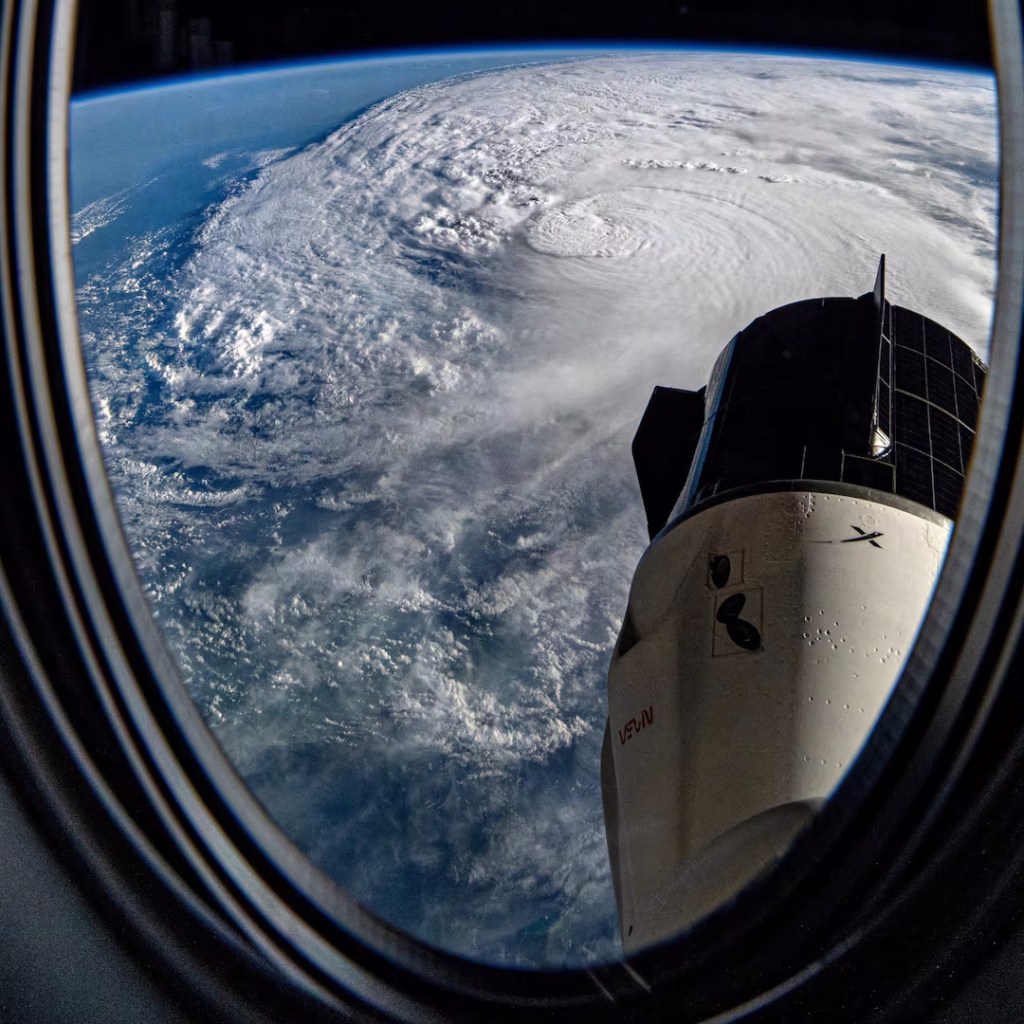
You likely need very little help from me to know the dreadfulness of Hurricanes Helene and Milton. From its center to its malicious extremities, Hurricane Helene was estimated to be 502,000 square miles in size. I did a little math. For perspective, that’s larger than France, Germany, and Italy combined. And then, with seemingly very little breathing room, Hurricane Milton—125,000 square miles of viciousness—tore through Florida in a little more than 24 hours. Thankfully, it weakened from a Category 5 to a Category 3 when it hit land. Nevertheless, it left more ruin in its obliterating wake.

I’m sure, like me, you were attuned to the events. I watched videos of the awful winds. I saw the overwhelming storm surges in Florida and swollen rivers sweeping away entire hillsides in North Carolina. I gave my fullest attention to the reporters visiting and describing the devastation. I listened to the tearful pleas from people who’ve lost everything in mere moments. And by everything, I mean family and friends. As of this morning, Helene claimed 260 lives. Milton took 17. It’s all very heartbreaking.

But there’s more to the story.

Even as the winds were still shaking walls and rattling glass, neighbors were helping neighbors. People were coming to one another’s aid. Everyday people cleared washed-out roads. Local business owners delivered generators. Strangers sheltered strangers from danger, giving them food, water, and a place to sleep.

All this happened long before FEMA arrived sharing online links to emergency loans to people with no internet access. All this continued even as Kamala Harris, the nation’s Vice President, went on Stephen Colbert’s show in full campaign mode for a “beer summit” and an opportunity to laugh about this and that, with no mention of the crisis. All this continued as President Biden, when asked by a reporter if the people in the storm zones were receiving the help they needed, fumbled to remember what the reporter meant by “storm zones.”

In all things political or civil, the ones who are so often piously “above it all” tend to lean on their favorite engagement escape hatch text, Psalm 146:3, which reads, “Put not your trust in princes….” In this case, they’re right to do so. The text refers to rescue. It refers to feeding the hungry and caring for the widows and the fatherless. Of course, the psalmist names God as the only trustworthy one when trouble strikes and needs are abundant. That said, Jesus told His listeners that when He returns in judgment on the Last Day, He will say to His believers, “Come, you who are blessed by my Father, inherit the kingdom prepared for you from the foundation of the world. For I was hungry and you gave me food, I was thirsty and you gave me drink, I was a stranger and you welcomed me, I was naked and you clothed me, I was sick and you visited me, I was in prison and you came to me” (Matthew 25:34-36). From there, Saint James offers rather straightforwardly concerning the Christian religion’s contours, “Religion that is pure and undefiled before God the Father is this: to visit orphans and widows in their affliction, and to keep oneself unstained from the world” (James 1:27).

To be clear, none of these things are teaching that salvation is dependent on our deeds. Good works are fruits of faith, and they are fully orchestrated by the Holy Spirit, who dwells in the believer (Ephesians 2:8-10). However, what we learn from these texts is that God regularly accomplishes the human care ascribed to Him in Psalm 146 through people. And so, I was by no means surprised to learn that neighbors were providing the initial and most crucial material and human resources, and in many cases, their help exceeded what the federal government was willing and able to provide. Where FEMA promised $750 to a hill-dwelling family to cover a catastrophic loss, churches both near and far, along with their denominational institutions, were already gathering funds to rebuild that same family’s home entirely.

Go figure. That’s what Christians do. We are the salt of the earth and the bright-beaming cities on this world’s hills. The deeds done are nothing more than the powerful glory of God at work through His people (Matthew 5:13-16).

I read very little modern fiction. However, someone who knows my appreciation for Lewis and Tolkien recommended I give Patrick Rothfuss a try. For the record, I probably won’t. Still, to investigate, I typed his name into Google. Along the way, I stumbled upon a potent quotation from his book The Name of the Wind. Rothfuss wrote, “There are three things all wise men fear: the sea in storm, a night with no moon, and the anger of a gentle man.”

That’s an intuitive sentence. The ferocity of nature, such as a stormy sea, is something a wise man fears because he knows its potential for danger. A moonless night of pitch-blackness provides cover for enemies and creatures we can’t see and yet would harm us. Therefore, a wise man avoids being out on such evenings. That same wise man also knows that when a person with an ordinarily gentle persona—someone from whom we’d only ever expect passivity and calm—when that person is moved to action, watch out. It’s likely an unstoppable conviction that’s driving him.

All of this prompts another thought. Well, actually, two.

First, I think we heard from the gentler man after the recent hurricanes. I think Helene and Milton juxtaposed the fire hose of billions of free-flowing cash to foreign countries with so many of our own citizens who couldn’t get the help they needed when they needed it. Because of this, I think the ordinarily quiet man is going to make himself heard in the forthcoming election. I think his voice will resonate long after. The hard truth is that people who just want to go to work, go to church, enjoy their lives and families, and all the things that a peaceful and dignified societal context provides are becoming frustrated. They don’t want to be forced to say a man is a woman when he isn’t. They’re tired of people like Gretchen Whitmer, Michigan’s governor, mocking sacred things like Holy Communion and then gaslighting them, saying what they saw is not what they saw. They’re tired of being forced to sit through DEI and CRT training at the office. They don’t want to feel as though they’re inherently and unforgivably racist because of the color of their skin. They don’t want their children’s teachers to indoctrinate them with confused sexual ideologies. They don’t want their parental rights stripped away. They don’t want their already exorbitant taxes to become monthly paychecks to illegal immigrants. They don’t want those taxes to pay for the same illegals to stay in posh New York hotels while their neighbors in North Carolina receive a few dollars during a disaster. They don’t want any of this.

Second, we heard another quiet man’s voice before, during, and after the hurricanes. We heard from those who live quiet lives of Christian conviction. Their faith proved capable of transforming fear into hope and ultimately showing a strength that could rival both the storms and the Federal government. Their Godly concern for genuine human suffering became a visible force that this sin-infected world and its princes just could not match.

I suppose Hurricanes Helene and Milton are reminders that while nature’s fury is something to be respected, there’s something else—or I should say someone else—far more awe-inspiring and worthy of our reverence: God. His rule has no limits, and His reign is forever, just as the Psalmist declared. More importantly, He cares. He is not distant. He’s close—closer than close can be. Faith knows that He’s so close that He’s often extending a helping hand through a friend or even a stranger. That moves us to thankfulness, first to Him and then to the agents of His manifested care.

Amid these current disasters, I’m not surprised the Christians have made an incredible showing. I bear Godly pride for my own Lutheran Church-Missouri Synod’s response. What a tremendous response from gathered Christians whose eyes are firmly fixed on Christ! But what else should I expect? That same Christ told us it would be this way. His servant, Saint James, did, too. God promised there would be people ready to step into the gaps—neighbors who would help when help was needed, who would ride out the storm while sheltering others through it, and then would remain in the aftermath to rebuild. We’re seeing this.

God be praised for His faithfulness!

A Tiny but Divine Juggernaut

The feeling is always the same. The day after the conference here at Our Savior, there’s a lingering sense of exhilaration and anticipation. For most in attendance, I’d say the exhilaration erupts not only from the opportunity to meet people they usually only see on TV but also from a newfound passion to engage in the world for the sake of preserving our nation’s founding ideals, which is nothing less than the societal context Saint Paul insists that Christians pray for and intercede to maintain (1 Timothy 2:1-6). He said we do this so that “we may lead a peaceful and quiet life, godly and dignified in every way” (v. 2). But to what end? Again, Paul helps us, writing that such a context “is good, and it is pleasing in the sight of God our Savior” (v. 3) because He “desires all people to be saved and to come to the knowledge of the truth” (v. 4).

All of this is to say that when religious liberty is secure, the freedom to preach and teach the most important message the world has ever known is more widely available. And what is that message? Paul tells us: “For there is one God, and there is one mediator between God and men, the man Christ Jesus, who gave himself as a ransom for all, which is the testimony given at the proper time” (vv. 5-6).

There’s an excitement that comes with playing a role in this preservative action, especially when it so often seems at every turn that Christians have their backs up against the wall. Of course, we’re not inserting ourselves because we somehow think God needs our help to maintain His world. We engage because He invites us to. Interestingly, the same Gospel we’re supporting has already moved us to love Him in ways that embrace His invitations, no matter where they may lead. Luther referred to this Spirit-driven compliance as a believer’s duty. In his explanation of the First Article of the Apostles Creed in the Small Catechism, he wrote that in response to God’s “divine goodness and mercy, without any merit or worthiness in me… it is my duty to thank and praise, serve and obey Him.”

Indeed, this is most certainly true. And so, we do.

I talk with a lot of people at our conference every year, and each conversation is an enlightening one. I learn something from every person I meet. One particular takeaway from this year’s conversations happened after everything had concluded and we were cleaning up. I spoke with a woman who expressed feeling helpless to change things for the better in America. But no sooner than she said this did she thank God for what she received from our conference, describing it as superbly educational and, thereby, motivational. And then, as if wrestling with her own premise while speaking, she found herself insisting that even the slightest, most insignificant effort to engage has a way of eclipsing that helpless feeling.

I grew happier as she spoke. Why? Because without even referencing it, she essentially reiterated the conclusion to the speech I’d given only a few hours prior. She was even now digesting what was said and talking herself toward the realization that faithful engagement comes in different shapes and sizes. The size and shape are determined by God and the gifts He gives.

Stepping from this point of origin into the public square, worry’s inevitable hopelessness is overshadowed by hope’s possibilities born from God’s gracious care.

That’s what I meant at the beginning of this note when I mentioned the lingering sense of exhilaration and anticipation. Again, the exhilaration comes from getting into the game and playing hard. The anticipation is the perpetual hopefulness that, while I might not be the best player by any worldly league’s standards, God still put me on His team. His squad is not made from this world’s muscle. If you doubt this, consider Saint Paul’s perspective in 1 Corinthians 1:26-30:

“For consider your calling, brothers: not many of you were wise according to worldly standards, not many were powerful, not many were of noble birth. But God chose what is foolish in the world to shame the wise; God chose what is weak in the world to shame the strong; God chose what is low and despised in the world, even things that are not, to bring to nothing things that are, so that no human being might boast in the presence of God. And because of him, you are in Christ Jesus, who became to us wisdom from God, righteousness and sanctification and redemption, so that, as it is written, ‘Let the one who boasts, boast in the Lord.’”

Paul isn’t just implying that each and every Christian is on God’s team by faith, lest any of us think that our salvation is based on deeds. He’s also making sure we understand that to look in the mirror and determine one’s value or potential for service to His kingdom according to worldly standards is to make a grave error. God doesn’t work that way. If He did, then the innocent Son of God would not have been given over to death for the sins of the guilty. He’d have left us behind right after the events in Eden, inevitably allowing us to get what we deserve. Instead, Jesus, the epitomizing demonstration of God’s backward way—God’s Son pinned to a cross in what appears to be pathetic weakness—is the mightiest of death blows to Sin, Death, and Satan.

This Gospel is itself the muscle and skillset that outmaneuvers our wisest and strongest opponents. It strengthens its team to suffer the heaviest tackles while still getting up and getting back into formation. It is, by all means, the best play in God’s playbook—the one that, since the beginning of time, Satan and his knuckleheads just can’t seem to figure out how to stop.

We are on God’s team. We didn’t get there by trying out. He baptized us into our respective positions. He has endowed us with what’s necessary for making a difference. And so, we play as hard as we can. We use the gifts God has seen fit to grant us, putting them to work to move the ball down the field toward the goal.

The after-conference conversation I mentioned began with a sense of individual irrelevance and ended with courageous invigoration. For as challenging as it is to assemble and administer a conference like ours, I’ll be forever glad that we do it if only to be reminded that, as the saying goes, where there’s one, there are another five. In other words, my momentary conversation partner—a relatively small woman by human measurements—was by no means the only one refreshed for gameplay. And the thing is, if God continues maneuvering as He does (which I know He will), the world is never going to see this tiny but divine juggernaut coming.