Your Home is Worth Fighting For

Vacations are nice, but home is better. I’ve heard it said that anyone can make anywhere a home—that our roots are portable. That may be true for some. For the rest of us, there’s another, more deeply rooted instinct. No matter where we are or where we’re going, at some point in any adventure, it’s likely we experience home’s gravitational pull. We find ourselves amazed by the exotic only to be equally astounded by the powerful need for what’s familiar. One of my favorites, Charles Dickens, wrote in his second volume of Martin Chuzzlewit that home is a word “stronger than any magician ever spoke, or spirit ever answered to in the strongest conjuration.” Maya Angelou described the desire for home as an ache that lives in all of us. For most, the ache means that no matter where we are or who we are with, the one place where we’re loved the most—where our absence is noticed the most—is home. As such, home always wins.

Today is my first day back from vacation. I needed the time away. I needed a burdenless pace for two uninterrupted weeks. It’s likely you know what I mean. It’s also possible you’ve experienced the jarring contrast of a vacation’s end. One minute, you were countless miles away, floating neck-deep in a swimming pool, and the next, you were neck-deep in man-made complications—two completely different pools of existence with very different demands.

Still, and once again, the ache proves stronger than the vexing differences. I’m home, and I’m glad for it. Measured against the “everyday” of life’s good and bad, it’s the place from which I set out each morning and the place to which I return each night. I go into the world to tackle or be tackled, and I return to my home knowing it’s where I most belong.

Interestingly, when I arrived at my “other” home (my office) this morning, things were a little different. It wasn’t anything significant. A few things were moved or added to my desk, a couple of books had been borrowed (thankfully, appropriate notes were left behind to track the borrowers), and my message box in the main office was no longer empty but full. Because these changes were slight, the overall vibe of “home” was intact. Imagine if I’d returned and my desk was gone, or cement blocks existed where my windows used to be. The ache would likely be lessened; maybe even gone altogether.

Before leaving for vacation, Pastor Pies, our emeritus pastor and my predecessor, stopped by with a copy of his doctoral thesis. I’d asked if he might allow me a copy to take along on the plane. He graciously obliged. The title of his thesis (which he tested among God’s people here at Our Savior in Hartland, Michigan, back in 1991) is “Christian Preaching as Dialogue in an Evangelical Lutheran Church.” Fancying myself more interested in the science of sermon preparation than most, I was glad to read it. For example, I appreciated that after making the case for preaching as God’s work through faithful ambassadors (2 Corinthians 5:20), Pastor Pies insisted, “Neither the power of God’s Word nor the operation of the Holy Spirit should be punctuated so as to excuse or justify inept preaching.” He went on to say that while God’s Word is efficacious, preachers have a “responsibility to preach it in a relevant way, sharing its timeless message in a timely manner…. This necessitates, in addition to prayer and the guidance of the Spirit, hard work under the blessing of God.”

I appreciated those words. They’re quite valuable. Still, something less conspicuous near the thesis’ beginning stood out for me, too. While explaining the setting for his study, Pastor Pies described Hartland, Michigan as a like-minded community attempting “to preserve everything they believe worth preserving while incorporating that which they consider to be valuable and useful.” He went on to describe the useful and valuable things as traditional social values, home and family, neighborhood unity, and community cooperation.

I had a thought. If, after writing this in 1991, had Pastor Pies been suddenly abducted by aliens, only to be returned to Hartland in July of 2024, would the ache he likely felt for home all those thirty-three years had been soothed? I ask this because a man who thinks he’s a female cat is currently running for a seat on the Livingston County Board of Commissioners. I ask because I’ve been in the company of elected officials openly commending the idea of biological boys being allowed to compete in female sports and use female bathrooms. I ask because local cohabitation rates are very nearly eclipsing traditional marriage. I ask for other reasons beyond even these.

In short: so much for Hartland as a place of traditional social values. So much for Hartland as a place for home and family. By the way, how’s it going in your corner of the nation—the world? Did you happen to see the opening ceremony for the 2024 Olympics in Paris this past Friday? Leonardo da Vinci’s portrait of the Last Supper was parodied grotesquely. Drag queens and all, it was a deliberate mocking of Christianity. Some are now trying to say it wasn’t, but most honest observers aren’t buying the new back-peddling. The similarities were far too obvious, and it’s nothing less than gaslighting to say we didn’t see what we saw.

I remember watching the Olympics as a kid. The opening ceremony was always a heart-lifting demonstration of world unity through competitive excellence. Not so much anymore. And, of course, Christianity is forever the easiest target. The Parisian magazine Charlie Hebdo printed a cartoon image of Muhammed a few years ago. The magazine’s office was firebombed, and nineteen people were attacked and killed.

As I prefer to remind folks on occasion, today’s world is a distant and alien land compared to what it once was. That said, there’s something else that can be said about your home.

It’s worth fighting for.

I’ve heard it said that fighting to preserve one’s home is not a choice but a duty. I agree. And while I’m no fan of Friedrich Nietzsche, he once wrote, “He who has a why to live can bear almost any how.” Again, I agree. Considering one’s home, the genuine ache we experience for it is, for many of us, the only “why” we need to push back against and endure almost anything that would threaten it.

Threats against one’s home abound. In America, one of the most important ways to protect your home is by voting. It’s not an end-all action by any means, but it is a significant one. Here in Michigan, several key voting dates are approaching. For example, Friday, August 2, is the deadline to request an absentee ballot for the upcoming Primary Election on Tuesday, August 6. Sunday, August 4, is the last day for early voting in the Primary Election. Concerning the 2024 General Election on Tuesday, November 5, early voting begins on October 6. October 21 is the deadline for registering to vote in the election in any form. November 1 is the deadline for requesting an absentee ballot.

Let these dates meet with your aching for home. Let each be an opportunity to remember its value. In faithfulness to the One who gave it (Hebrews 3:4), act to protect and preserve it. Choose candidates who will lead in ways that uphold God’s moral and natural law so that, if you’re ever absconded for thirty-three years, when you return home, it will still be home, not only for you but for generations to come.

Real Family

I tell myself every year I’m not going to write and send an eNews message while on vacation. Every year, I fail to keep this pledge. I know why. There are two reasons.

First, it’s because I’m a writer at heart. For me, writing is far more than a byproduct of my task as a pastor. It’s in my DNA. Somewhere along the twirling genetic strand responsible for my development as a human being is a switch. In the off position, writing is a chore. But mine’s been flipped to the “on” position. I do it because it’s who I am, and as such, it’s harder to avoid writing than it is just to sit and do it.

My wife, Jennifer, more or less highlighted the second reason I continue to fail at keeping the “no eNews” pledge. It happened during a relatively recent conversation between us concerning death. She asked where I’d like to be buried. Assuming the conversation wasn’t hinting at a secret desire to off me in the pool while away, I floated along in its stream, implying I didn’t really care where the family returned me to the ground. My only two requirements have been that I not be cremated and that the mortician embalms me with my remaining whisky, fully aware that, even as I’m friends with many of the funeral directors in the area, the former is more probable than the latter. Beyond that, the family can sink me in the pond in the backyard for all I care.

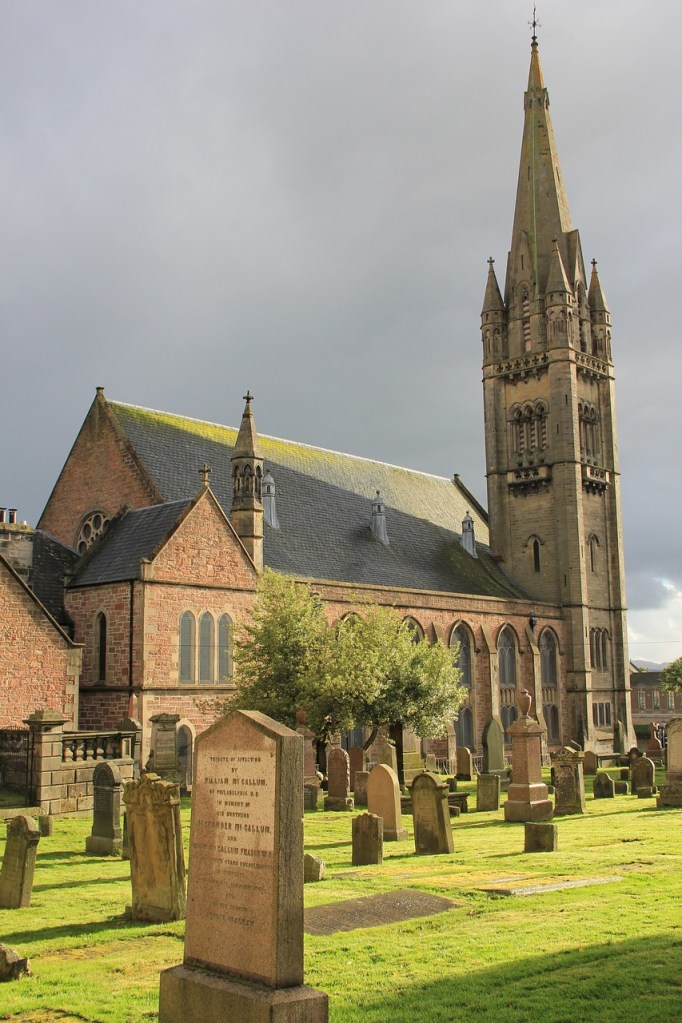
From there, Jennifer asked if our church had ever considered using some of its property for a cemetery. I told her it had been discussed at one time years ago, but nothing ever came of it. It was then she betrayed a profound love for the people in our congregation and how she didn’t want to be buried in a random cemetery somewhere. When it came time for her burial, she wanted a place where she, and perhaps the generations of Thoma kin to follow, could be laid to rest together with their realest family—their church family. When she said that, not only did I know she was describing something I somehow knew I also wanted but never realized, but I understood why I would continue writing a message like this on vacation when I really don’t have to.

It’s because I love my family. The hundreds of people who receive this eNews every week at Our Savior Evangelical Lutheran Church in Hartland, Michigan, where I serve as pastor, are a part of that family—my realest family. Along with my immediate family, these are the people who, when the final trumpet sounds and our corrupted bodies are raised incorruptible to stand before the throne of Christ (1 Corinthians 15:51-57), I will count it all joy to experience this beside them. I’d count it a privilege to be alongside the Christians among whom I lived and breathed and served and worshipped in this life.

Maybe it’s time to revisit the idea of a church cemetery. With twenty-six acres, we certainly have the space. I’ll leave that to the church leaders at Our Savior, who may be reading this right now. To everyone else, I’ll simply encourage you to give thanks to God for your church family. In this life and the next, they’re the realest family you’ll ever know.

By the way, for the editors out there, I know “realest” isn’t a word. I just like how it sounds.

The Theater of Humanity

We arrived in Florida a little differently this year. Jennifer drove. She left a day early with Harry and Evelyn. I flew. Madeline went with me. It’s better that I flew to Florida and didn’t drive. My back is terrible. More than three hours in the car equals a few days of vacation ruined. That’s how long it takes me to recover, and I need every day I’m away to be as vacationy as possible. Indeed, I need two unscathed weeks of palm trees and a pool.

Unfortunately, when we landed, our phones exploded with the news that President Trump had been shot. Some of you texted me. Others left voicemail. Thanks be to God he’s okay. Now we pray for the families of the casualties and injured. Usually, I’d suggest praying for the perpetrator, except he’s already been neutralized. Now, he answers to eternity. Had his life been spared, we might know more. It’ll be a lot harder to get to the bottom of things now that he’s dead.

The White House noted that the FBI would be running the investigation. I wonder how Trump’s folks feel about that given the agency’s relative weaponization against him. By the way, I don’t say that lightly. I was nominated and accepted into an eight-week citizen’s training with the FBI this past spring. I learned firsthand just how partisan the agency has become. Passing jabs at conservatives was common. So were the excuses for “mostly peaceful” groups like Antifa, Black Lives Matter, LGBTQ, Inc., and Pro-choice extremists. I’m by no means inclined to believe the FBI has President Trump’s well-being in mind. They answer to ideologues who rile crowds, comparing Trump to Hitler and labeling him a “threat to democracy” and “the end of America.” Their boss, Joe Biden, rasped at a recent fundraiser, “It’s time to put Trump in a bullseye.”

It appears someone may have been listening.

I hope I’m wrong about the FBI. I hope I’m wrong about Biden and his administration. I hope they’ll get to the bottom of this. I also hope their gabbling is nothing more than campaign rhetoric. I hope the Democrats’ continued stoking of the so-called tolerant left and the subsequent assassination attempt are only coincidental. Either way, the images of Trump covered in Secret Service agents—a man who’s been through so much, the American flag now billowing above his blood-smeared face, his breaking through the agents’ shielding to fist-pump the word “Fight!”—this image was seared into the hearts and minds of billions worldwide. It will unify many.

This has me thinking of something else.

I began by saying there aren’t too many things I like more than palm trees and a pool. That said, there’s almost nothing more entertaining than an hour in an airport terminal watching passersby. You never know what you’ll see. A woman dragging her angry child by a leash a short distance across the airport floor, his shoes squeaking like well-worn brakes as he tries to hinder her momentum—an oblivious tween wearing headphones two paces behind the struggling mother. A heftier man with bleach blonde hair and fishnet over a bright t-shirt doing all he can to be a woman but without an ounce of success. Two clerics in flowing cassocks pulling bags, and one has a cane that he doesn’t appear to need for walking. A beeping trolley with an elderly woman in its passenger seat. An eager crowd of Florida-bound travelers waiting and watching a bedraggled ensemble disembark an arriving plane, their vacation has come to an end. Atop all of it, a bird that somehow found its way inside and is now flittering from steel beam to steel beam above the unsuspecting bustle.

Like the bird, an inconspicuously observing man with his own past, present, and future sitting beside his oldest daughter and thinking, “I wonder what else there is to these people.”

For as weird as the theater of humanity might be, I appreciate individuality. Each person is gifted and uniquely valuable, no matter who they are or what they believe. If this were not true, Christ would not have told Nicodemus about God’s love extending itself to the extremities of death for the whole world (John 3:16). He would not have told His disciples, “Look, I tell you, lift up your eyes, and see that the fields are white for harvest” (John 4:35), which was to say that every person in this world is worth laboring to retrieve.

Still, the importance of uniqueness has become misapplied, reaching a fever pitch in society. We currently exist in a culture hellbent on amplifying individualism above everything else, the result being extreme division. The attempt on Trump’s life is proof. Perhaps just as worse, society has learned to praise and protect abnormality while shaming normalcy. A person who wants to get married, have children, go to church, and live a relatively normal life is considered the epitome of mindless conformity. But a man who disrupts the community of “family” and “friends” by quitting his job, divorcing his wife, and leaving his children to embrace his most authentic self as a six-year-old girl is heralded as courageous. Get in his way, and you’ll be sorry. Try to help his family, and you’re a bigot to be canceled.

I’m reminded of something Rev. Henry Melville wrote. Unfortunately, his words are often misattributed to Herman Melville, the author of Moby Dick. Nevertheless, Rev. Melville insisted in a sermon he delivered in 1855, “Ye live not for yourselves; ye cannot live for yourselves; a thousand fibers connect you with your fellow men, and along those fibers, as along sympathetic threads, run your actions as causes, and return to you as effects.” This is sermonically reminiscent of Saint Paul’s warning, “The eye cannot say to the hand, ‘I don’t need you!’ And the head cannot say to the feet, ‘I don’t need you’” (1 Corinthians 12:21). And yet, society has grown to despise such a message, and now we have a mess of self-concerned, handless, and footless bodies. We have a mess of separate and nearly unnavigable identities, with more and more people inventing new ones every day, each highlighting its own supposed uniqueness. In short, it has become commendable to cut the fibers that bind us to community. It has become laudable to stand entirely apart.

Yes, we’re all unique, and our individuality is essential. But our sameness is, too. In fact, it’s individuality’s point. We have roles to play in something bigger. This is true in microscopic ways, such as individual talents and skillsets used to support an organization, but also in much grander ways. A man or woman is only one-half of the single most important society-perpetuating and stabilizing equation. Relative to the Church, it’s why Saint Paul wrote, “For as in one body we have many members, and the members do not all have the same function, so we, though many, are one body in Christ, and individually members one of another. Having gifts that differ according to the grace given to us, let us use them” (Romans 12:4-6).

Use them for what? For the benefit of the community. This is a divine nod to something significant.

The more radically individualized and disconnected from community and its normalcy we become, the more our society seals its doom. We’re already seeing airplane crashes because a more qualified engineer was overlooked for another with lesser skill but with 7% more Cherokee DNA. Even now, people are losing the will and ability to communicate in fundamental ways, having become utterly incapable of engaging in honest conversation for fear of using incorrect pronouns and offending someone’s made-up uniqueness.

While I’m people-watching, I certainly do wonder about individual backstories. However, in the end, I’ve realized I can only really do this through the lens of sameness. I suppose therein lies one of life’s greatest ironies, which I’ve heard phrased, “Each of us is different, just like everybody else.” The adults before me were all children once. I wonder about the uniqueness of their upbringing. They all eat food. I imagine their favorite meal. I also wonder about their struggles. Everyone has sins that they wrestle to keep hidden from others and themselves. White or black, tall or short, we’re all members of the fellowship of sinful human dreadfulness. Rich or poor, well-known or societally invisible, God does not show partiality and cannot be bribed (Deuteronomy 10:17), and, therefore, none among us is above or below the other relative to the need for a savior.

But here’s the thing: even as God formed each of us as unique individuals, His greatest gift took aim at our sameness. He sent a Savior for all. By the person and work of Christ—His life, death, and resurrection—the whole world’s redemption was accomplished. He didn’t do it one way for Americans and another way for Somalis. We’re all the same in this. No one stands beyond the blast radius of the cross. Only according to this perspective does a genuine uniqueness come to light.

Those who believe this Gospel of redemption become the truly exceptional ones. They’re made holy. To be holy means to be set apart. Believers are set apart from a world intent on self-promoting shouts of uniqueness from the mountaintops. This world is set on having things its way—on doing, saying, and being anything it wants without consequence, all the while expecting commendation for the insanity. The Gospel for faith changes this. It’s the only thing that really sets a person apart, while at the same time drawing the one it inhabits to a better frame of reference. Suddenly, a person’s uniqueness becomes consequential to more than just the self. It becomes less about the spotlight and more about community. It’s moved to enact selfless love for the neighbor. And still, it knows more. Concerning the Church, suddenly, the community’s boundaries and preservation become paramount. That’s one reason why I appreciate tradition so much. It’s why the historic liturgy and the creeds are so valuable. They help bind and fortify the eternal community across time and location.

To wrap this up, I suppose I’ll close by acknowledging my appreciation to God for your uniqueness. I also give thanks for the more spectacular sameness of God’s love in Christ that binds us together in community. This sameness testifies to our value as individuals in the only way that truly matters.

Arlo is No Quitter

The sun is just now on its tiptoes and looking over the horizon. Its ginger hair is streaming up and outward across the sky. So long as the clouds stay away, in a few minutes, its locks will be torrents of shimmering blondes, eventually becoming brilliantly invisible against a crisply blue sky.

Summer is the best. It hijacks my sense of direction. Almost every inclination leads me outside, no matter how hot it might be. The only problem for a guy who simply cannot shake the need—or, as Longfellow described, the desire to be “up and doing”—is to figure out how to best use the time and opportunities available. Although, there’s more to Longfellow’s little psalm. He wrote:

Let us, then, be up and doing,
With a heart for any fate;
Still achieving, still pursuing,
Learn to labor and to wait.

Indeed, we must be ready and willing to embrace and use each day’s peculiar opportunities. A lazy life of disinterest is no life at all. Still, we also must be sure to wait. In other words, rest exists in between the doing. One of the busiest men who ever lived, John Lubbock, was a husband, father, banker, archaeologist, politician, writer, vice-chancellor at a university, and likely so much more. Still, he made time to share with the forthcoming generations, “Rest is not idleness, and to lie sometimes on the grass under trees on a summer’s day, listening to the murmur of the water, or watching the clouds float across the sky, is by no means a waste of time.”

I think Lubbock was right. Although, I’m often the last one to take his advice. I know that needs to change.

Taking a brief moment away from typing this note, I just saw a familiar chipmunk outside my office window. A few weeks back, I started calling him Arlo. I don’t know why. He just looks like an Arlo. Anyway, stretching my legs, I moved to the window to watch Arlo skittering here and there and up and down the nearby tree. When I saw what had just happened to him, I was reminded of something.

I’ve mentioned in previous writings that while I don’t watch much TV, Jennifer and I have been taking time in the evenings on occasion to watch nature shows. I think she has officially become one of David Attenborough’s biggest fans. That said, and in full stride with his raspy voice, we’re both learning quite a bit about the natural world. Relative to animals, I’ve noticed something—well, maybe a few things—especially when it comes to the “up and doing” life so often requires.

In the wild, I’ve never seen a lazy animal. I’m also yet to see an animal exhibit self-pity during trouble or make excuses for its unfortunate plight. In fact, it’s always quite the opposite. Their resilience and determination are inspiring. It usually takes a pride of lions to fell a buffalo. There’s a reason for that. Buffalo aren’t quitters.

Arlo, the critter outside my window, is by no means a buffalo. Still, he’s another example somewhat closer to home. He is, right now, working feverishly to gather bits of something from the sidewalk beneath his tree. A moment ago, while I was watching through the window, he was dive-bombed by a swooping bluejay. I don’t know if bluejays catch and eat chipmunks. I know they catch and eat smaller birds. I’ve seen them do it. Either way, the aerial attack certainly had the jittery little furball hopping to attention. He leaped and dodged before scurrying up the tree. Still, the seemingly caffeinated critter is right now back on the ground and at it again. Arlo’s no quitter. Of course, he pauses every few seconds to check his surroundings. Still, he’s not in the tree making excuses. He’s not complaining to his friend Steve, the squirrel in the tree next door, about how everything appears to be against him. Arlo’s tiny. He’s weak. He can be swallowed whole. Still, he’s undeterred. He’s going to do what he came to do. If trouble arrives, he’ll deal with it accordingly. Until then, steady as he goes.

I’m rooting for you, Arlo, so long as you don’t find your way into my office and chew through any of my books.

Watching this through the Gospel’s lens, I suppose part of this morning’s outing is to say that while life is a balance between action and rest, both bring opportunities for Godly reflection. Doing what I’m doing here at the computer is not necessarily rest. It requires my brain to be up and doing. And yet, it is a laborious opportunity to reflect Christ to others. Taking a minute to rest and watch Arlo was reflective, too. His unwavering determination was a reminder that no matter how small or vulnerable anyone may be, no matter the troubles that come, I can run life’s race of work and rest with confidence (1 Corinthians 9:24-27), committing each of my days to the Lord knowing that He will care for me according to His good and gracious will (Proverbs 16:3).

God bless and keep you in the forthcoming day. I pray it affords you time to ponder the Lord’s love, no matter what you may be up and doing.