
Apart from our basement living space, which is a visual explosion of movie memorabilia, the rest of the Thoma home betrays our minimalist nature. We store nothing on the kitchen counters. The available shelves are not cluttered. The walls are mindfully decorated. As it is for most people, the wall adornments vary.
The stairwell is where the family photos hang. The only other place we display family pictures is in the master bedroom. There are four images of the children on its north wall. A uniquely designed horizontal frame with wedding photos is on the south wall above our bed. Excluding the furniture (which includes a fireplace mantle Jennifer and I restored and put on the longest wall), the rest of the bedroom’s walls are relatively bare.
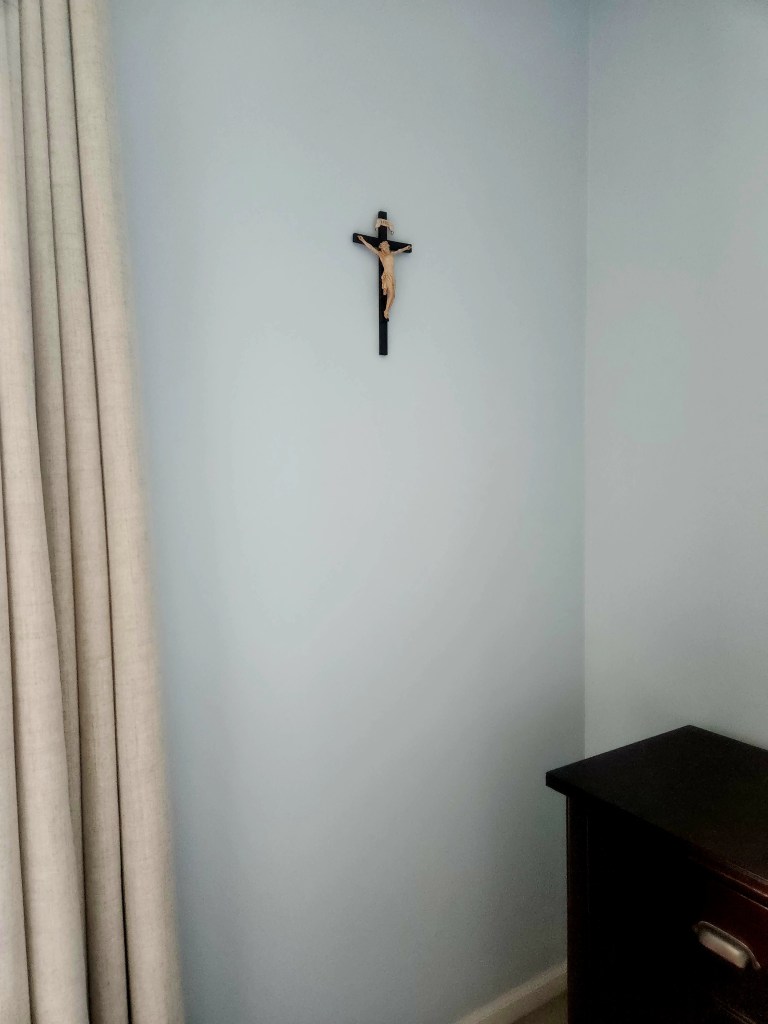
Almost every morning, I awaken on my right side. The first thing I see is a five-foot by eight-foot sky-blue wall with nothing on it. At least it used to have nothing on it. I bought and hung a 5-inch by 10-inch crucifix last week. Relative to the space, the crucifix is somewhat small. At first glance, it may even look swallowed up by the area around it. Still, I’m keeping it where it is. It’s crisply distinct, hovering as the space’s only focal point.
Interestingly, I can see the crucifix day or night. In the daytime, it casts a notable shadow. At night, after my eyes adjust, its contours are not lost in the blackness. It’s harder to see, but it is not invisible. There’s a unique comfort to be had by this, which means the crucifix is doing its job. But before I explain what I mean, I should clarify something else.
Some people despise the usage of crucifixes, icons, and other religious items. In their ignorantly hasty opinions, they blanketly consider them idolatrous, being little more than talisman-type objects that can only nudge God from center stage. Admittedly, some people do treat religious objects this way. I knew someone who once told me he put a Bible on his bedside table, not to read but to help him sleep more soundly. He believed its presence helped ward off evil spirits. That, of course, is ridiculous. Still, my guess is that most Christians don’t keep religious items around for such reasons. Instead, they have something else in mind.
Take, for example, the crucifix on the wall beside my bed. It’s where it is for a reason. I didn’t put it there for pseudo-spiritual reasons or because the wall needed décor. I’m not afraid of the devil, and Jennifer has more than decorated our bedroom, making it a cozy place of refuge and rest. I hung it there because it’s likely the first thing I’ll see when I wake up and the last thing I’ll see when I go to bed. I’ll see it when the lights are on or off, in the sunbeams of daylight or the pitched darkness of night.
A crucifix—a cross with a body on it—is the Gospel depicted. It’s a visual proclamation of Saint Paul’s words, “We preach Christ crucified” (1 Corinthians 1:23). It is a silent sermon wholly concerned with the person and work of Jesus Christ, the world’s Savior. That’s its job—to preach. You don’t worship a crucifix just as you don’t worship a pastor. Neither replaces Christ. Both preach Christ’s visceral efforts to defeat Sin, Death, and Satan. The preacher speaks it. A crucifix shows it. The one on my wall is no different. I awaken to its quiet preaching. I also close my eyes to it, finding rest in the Gospel promise of God’s forgiveness and care for me, a sinner needing daily rescue.
Relative to optics, there’s certainly more it teaches. I mentioned I can see it in both the daytime and at night. Things are simpler with the sunlight’s ease. You know what’s going on. You can see where you’re going. Your steps are freer and more leisurely. Life’s darker moments are harder. Terrors creep there. Perceptions are skewed. It’s far more difficult to see. Nevertheless, Christ’s payment stands. In the ease of daytime or the terrors of night, Christ’s sacrifice for our eternal future remains the solitary point of reference to everything this life presents. Faith sees it. It knows it. And it is at peace.
 Cruciform Stuff