I probably don’t need to point this out, but betrayal is the worst. To trust someone, only to feel the security of that trust torn away, is a sensation unlike any other. One could say it goes almost beyond physical pain. It may even be a pain equivalent to demon possession. I once heard demon possession described as a ferociously rabid animal trapped inside a person and trying to claw its way out. It tears and gnashes from the inside. The pain of betrayal—the sting born from a trusted friend’s infidelity—starts in one’s middle. It claws through the immaterial sphere of emotion into the material world. A pierced heart eventually feeds its suffering to the body’s extremities.
One starts to think that even Death would be better. At least Death’s enmity is reliable. There’s no bait and switch. It meets and gives to every living thing precisely as it promises. Betrayal, on the other hand, presents itself kindly while holding a knife behind its back. And when the time is right, it massacres trust with selfish concern.
It certainly isn’t easy to repair a betrayed relationship. That’s because, like any structure, genuine friendships have foundational components like honesty, history, loyalty, and honor. Take away any of those underpinnings, and the structure topples. The French poet, Nicolas Boileau-Despréaux, wrote that a person’s honor “is like a rugged island without a shore; once you have left it, you cannot return.” Betrayal is the boat into which honor willfully climbs and starts rowing away. Relative to friendship’s construction, betrayal explodes each of its crucial supports. In the end, the relationship has two choices when it collapses: scrap it or start rebuilding.
It seems we live in a world more inclined toward scrapping relationships. Set aside deliberate betrayal for a moment. For some in today’s world, a trivial misunderstanding is all it takes to flush a lifelong friendship down the proverbial toilet. Unfortunately, I know this. I know it not only because I’ve experienced it but because I’ve done it. Looking back at both, I wish I hadn’t. When someone scrapped me, I should have pursued the person. When I scrapped someone else, I should have tried to rebuild. But I didn’t. I walked away. I’m incredibly sorry I did. I’ve repented of this foolishness, and I fight the flesh in similar situations by God’s gracious strength. As a Christian, I’m gratefully nagged by an understanding of forgiveness’s power—giving and receiving it. Of sinners, I am the foremost (1 Timothy 1:15). And yet, even as the foremost of sinful betrayers, Christ died for me (Romans 5:8). His death won my eternity, and by the power of the Holy Spirit for faith, He’s made me His friend. He pursued me. He forgave me. His forgiveness repairs. His forgiveness rebuilds. His forgiveness instills the readiness to rebuild with others.
Admittedly, a readiness to rebuild doesn’t assure restoration’s success in a thoroughly sinful world. If you actually succeed at reconciliation, there’s no guarantee the relationship will be as it was before. It simply means you know real hope. You’ve met hope in the person and work of Christ, and now you prefer it to despair. Christian hope can navigate a world of throw-away relationships undermined by the simplest mistakes or the worst betrayals. It is willing to invest in a relationship’s repair because it knows the value of friendship. A car driven into a tree and then repaired will never be the same as it was. It’ll have parts that rattle. It’ll need extra attention. But it can still drive its occupants to the same locations. It can still carry its passengers to the same goals.
I’ll just come right out and say that I experienced significant betrayal this past week. It was the kind that really hurts. Still, I intend to pursue the relationship’s healing, not because I know I can fix it, but because I know Christ can. Looking to Him, the perfect Son of God who forgave me—the One who was not only betrayed into Death by those closest to Him but was victimized on a cosmic scale by the world He created and loved—I can certainly invite a former friend to join me in the rubble as I examine the damage and attempt to rebuild. If you’ve ever experienced the same, then I’m assuming you can, too.
Did your mother ever tell you it’s rude to stare? I’m pretty sure mine did. Granted, it was typically an instruction given relative only to people. Parents experience an entirely different form of concern when their children sit and stare at nothing. Good thing I’m the only parent in the entire building right now. Here I sit, staring out my office window. Although, I am not entranced by a strange-looking person, nor am I being drawn into a void of nothingness. Instead, a reasonably hefty groundhog is wandering around outside my window doing whatever groundhogs do. He appears to be busy scurrying and popping up and scurrying again. At one point, he popped up to look in my window. We saw each other. I said hello and told him he looked well-fed. He dropped back down to scurry away, only to pop up again as if to say, “Same to you, buddy.”
There are plenty of other things I should be doing right now. For one, I should be tidying up my sermon for this morning. It’s written, but it isn’t ready. And yet, I’m watching a groundhog. It’s not as if I haven’t seen one before. Or that groundhogs are all that interesting. It’s something else. It’s more that feeling one gets on occasion. I’m guessing you know the one. You begin looking at something, and after a time, you realize you’re locked on it in a lazy stare. You’re not necessarily interested in whatever you’re observing. You’re just looking. And as you do, you leave yourself for a moment.
Have you ever been doing this when someone suddenly asked you a question? One way to know it’s happening is that it takes several seconds to realize you’ve been asked a question and then a few more seconds to answer. And when you give a somewhat disjointed reply (because you began speaking while climbing back into yourself mentally), the person doesn’t thank you but inquires, “Are you okay?” I suppose it wouldn’t be out of order to respond, “Everything’s fine. I just stepped away from the control panel for a moment.”
Returning to the fact that I’m staring at the local wildlife when I should be working on my sermon, I get the sense that staring at someone can’t be all that bad. The Gospel reading for today is Mark 8:1-9. As Jesus directed the hungry multitude to sit, I imagine His disciples were staring at Him. Aware of the dire situation, they’d already asked Him, “How can one feed these people with bread here in this desolate place?” (v. 4). Rather than initiating a food search, the Lord instructed them to stay right where they were. That was weird. It invited astonishment, the kind that could easily become staring because it didn’t want to miss what might happen next.
My wife, Jennifer, is a gifted photographer. She’ll never admit it, but she has a visual sense about her that few others do. It’s a sense that employs staring—not the lazy kind I admitted to this morning, but the intently honed kind. Jennifer can spot things among casual scenery that most others will miss. Genuine photographers have this skill. Painters and poets do, too. They see things that others miss and then lock onto them. They look without flinching, observing the microscopic details. They learn by staring. They know a glimpse isn’t enough. They know you must look intently to truly see. By looking this way, they know they’ll be led to better, more substantial things.
When it comes to Jesus, this should be everyone’s rule. He’s worth far more than a superficial glance. Everything He says, everything He does, you don’t want to miss. There’s a purpose in all of it, and it’s entirely for His onlookers. That’s one reason any seasoned preacher will admit that even the most uncomplicated Gospel narrative can provide a lifetime of sermons. Every little detail relative to Jesus’ person and work—every single motion and word in every single context or conversation—aims for the miracle of humanity’s salvation. That salvation, and all its accessory minutia, must be examined and preached. To do so is to connect with the instance being studied and be prepared to understand other instances.
For example, observing Jesus here in Mark 8:1-9, I imagine that later on in the upper room on Maundy Thursday, when the Lord took the bread, gave thanks, and then broke and gave it to His disciples (just as He did with the multitudes in the wilderness), there were words and actions used that the disciples had seen before. It was an entirely different context, yet it was reminiscently similar. At a minimum, having paid close attention in the wilderness with the starving crowds, they’d know the Lord’s ability to take a single piece of bread in hand and, prior to giving it to anyone else, make it so much more than before He touched it. In the wilderness, one piece in the palm of His hand became five, and then ten, and then thousands upon thousands, enough that the uneaten leftovers filled seven baskets. Surely, a single morsel in the Lord’s Supper, surely a tiny sip from the Lord’s chalice, could be more than well-wishing symbolism. Certainly, Jesus can take hold of mundane things and extend their potential beyond human faculties for reason or comprehension.
Either way, these things are lost on those who are only willing to give Jesus a superficial glance, one that assumes it can sufficiently sort Him out in a drive-by interaction, ultimately considering Him to be just one spiritual guru among many. You can’t just pop up for an occasional peek, fitting him into your scurrying, and expect to be called a Christian. It’s better to stop and stare. You should watch Him closely. You should listen to Him carefully. You should mind what He’s doing, and as He does it, hang onto His every word (Luke 19:48).
Knowing that Christ is the Word made flesh, the same rule naturally applies to the Holy Scriptures. God’s Word is more than worth an irregular glance. Luther is the one who said, “If you picture the Bible to be a mighty tree and every word a little branch, I have shaken every one of these branches because I wanted to know what it was and what it meant.” In a mere practical sense, for Luther, a tree is a tree—until you examine it. When you stare into its branches with investigative eyes, you’ll see far more than a forgettable object with a trunk and green stuff growing out of it. You’ll discover details. You’ll see one branch leading to another—flowering adornments reaching out from countless stems covered in intricately contoured surfaces. You’ll find things living among the tree’s branches, lively creatures that call the tree home.
By the way, I think most pew-sitters can tell the difference between a pastor preaching from a drive-by glance at Jesus and one who has stopped to stare at Him. It’s not only revealed by the preacher’s care with words, but by the details his words are in place to carry. Telling the listeners about a tree is nothing compared to using words that lift them from the earth to set them into its branches. A tree remains an inconsequential construct until the preacher examines and then introduces you to it. That’s a reality relative to language.
Having said that, I should get back to the sermon-writing effort. In the meantime, consider your own willingness to stop and stare at Jesus. Is He of more interest to you than an occasional visit to church? Driving by, is He more than just another object decorating your intellect’s limited landscape? Is His value for life in this world and the next far more substantial than your rarely-opened Bible would betray? I hope so.
How about this? Pick a narrative from any of the four gospels. Long or short, read the same narrative every day for a week. After each textual visit, take some time to savor it. Think about what you read. Let yourself stare into it for a while. Do this with the same text each day for a week, taking a moment to jot down something you notice with each visit. My guess is that each interaction will provide a unique “something.” You might not understand the something right away. Still, you will have taken it in. And you’ll likely recall it right in the middle of another narrative somewhere else that may lead you toward understanding it. You may even begin to notice particular trajectories, ones that lead you from simple uses for water, food and drink, and so on, to other, more substantial truths—ones suggesting that there may be more to faith’s origin than you knew; or there may be more to baptism than you first thought; or there may be more to the Lord’s Supper than the one-size-fits-all church or the meme-assembled theologies have taught you.
I was gifted a slender volume years ago by a dear member of my congregation. Jeanette is her name. She’s now with the Lord. The book was hers as a child. Its title: “Literary Shrines.” The author, Dr. Theodore Wolfe, scribbled its 217 pages in 1895, but only after traveling to each of the locations he explains.
The book rests on the corner of my bar. Every now and then, I’d pour a two-fingered dram and turn a few pages. As I’ve done so, the book has served its purpose, which was to carry its reader into and through the communities and homes of the better-known among us—Hawthorne, Thoreau, and others.
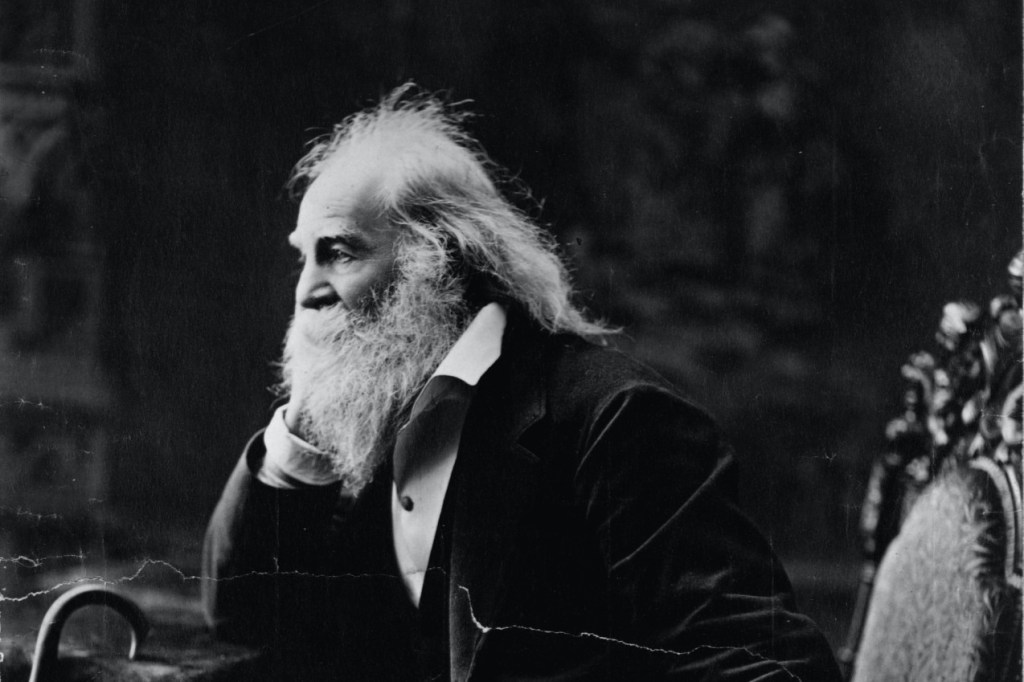
Having tipped one of the gentler bourbons in my cabinet, I finished the volume tonight. It ended at Walt Whitman’s house in Camden, New Jersey. Dr. Wolfe described the poet’s home at 328 Mickle Street, a “disappointingly unpretentious two-storied domicile…weather-worn and shabby,” he called it, with “W. Whitman” etched plainly on the doorplate.
But something else struck me about this concluding narrative.
Dr. Wolfe was taken to and left at Whitman’s home by a man who knew Whitman. Apparently, everyone in 19th-century Camden knew him. But this conductor, in particular, spoke rather peculiarly. Before leaving Dr. Wolfe to investigate, he said, “You have only to cross the ferry and apply to the first man or woman you meet, for there is no one in Camden who does not know Walt Whitman or who would not go out of his way to bring you to him.” He continued, “I never read a word Whitman wrote. I don’t know why they call him Socrates, but I do know he never passes me without a friendly nod and a word of greeting that warms me all through.”
I liked that.
Firstly, he spoke of Whitman as though he were still alive. I’m not surprised. Such people live well beyond their mortal departure. Secondly, Whitman—a favorite of mine—is described as everything I’d want him to be: kindly, gentle, aware of so much more than himself. Here was a man who more than dwelt among eloquence’s immortal collegium. Still, when you were near, he saw you, and he was interested.
If Walt Whitman, the most influential poet in American history, can have such a legacy, what about any of us?
It feels like the summer is flying right by. Thankfully, I do have things to show for it. I’m certainly not wasting time.
As a parent, I keep on my kids about things relative to time. For example, I occasionally remind them in my own way that someday will eventually become today, and unless you’ve planned accordingly, what today requires will be entirely inaccessible. A person simply cannot live without thinking of the future.
In some discussions with my kids, I try to steer them toward calculating one’s self-sufficiency relative to backup plans. In other words, you cannot always rely on other people. They will let you down. In the same way, you cannot always count on the things you think you can count on. Things wear out and break. Apart from syncing to a cloud-based drive, it’s why I have two external hard drives, each backing up from my computer’s working drive every four hours. It’s why I always bring my laptop to my church office every Sunday morning. If my office computer has problems, I can use my laptop to write and send the eNews and, if necessary, finish my sermon and the service prayers. It’s also why I’ve learned how to use my cell phone as a hotspot. If the internet is down on Sunday morning, I can still get this eNews message sent. It’s also why I have a second printer in my office. If the office printer is down, I can still print anything I might need in a pinch.
I didn’t always live my life this way. But I do now. A few unfortunate circumstances over the years taught me just how right Ben Franklin was when he said that failing to prepare is to prepare to fail. As a result, I do what I can to have a backup plan. Most often, I have two, and sometimes, even three.
I don’t mean to say that the future is controllable. It isn’t. Only the Lord knows what will or will not be, and plenty of people have prepared for the future in every imaginable way, only to suffer future-shattering tragedies beyond their control. For all my planning, I once showed up to the office on a Sunday morning and, attempting to print my sermon manuscript, discovered the office printer was down, the ink in my second printer had dried up, and I had zero replacement cartridges. I had to write it by hand. Twenty-eight years ago last week, my twenty-four-year-old brother Michael was killed in a car accident. Here I sit today, still astounded that he’s not around. His absence was something my family and I never expected.
Simple or grand, even when you prepare, tomorrow is never for sure.
I read a portion from Luther this morning in which he wrote, “Christ has not freed us from human duties but from eternal wrath.” He goes on to say that even as we strive and prepare, the only certainty we’ll ever truly have is situated in Christ. Faith receives that certainty. It can receive it because it understands what laboring in this fallen world as a responsible human being means, even when we know everything we’re doing could be for naught and could all come crashing down. Before it even begins a task, faith admits to human brittleness and life’s uncertainty. From there, it plods along diligently, knowing that you win some and you lose some. Faithfulness, not success, is key. It can live this way because its mortal future isn’t its final future. It is secure in Christ for a future beyond all futures. Destruction is not the last word for believers, not because we worked hard or devised a plan to avoid Sin’s inevitable wage, but because God had a plan for carrying us through it. He enacted that plan in Jesus, the God-man in whom faith is placed.
Relative to this, Christians do work hard. And they plan. Leaning on Luther, he mentions God’s gifts of reason and sense in his explanation of the First Article of the Creed in the Small Catechism. Our reason and our senses make these things possible. But remember, as Christians prepare, they measure their futures by looking through Gospel lenses. Faith doesn’t make plans apart from looking to Christ. Faith does not plan a vacation without planning a way to be present in worship while away. Faith does not invest financially without mindfulness for Christ and His bride, the Church. Faith considers the Gospel’s perpetuation for future generations when voting today. Faith plans, all in faithfulness to Christ and the benefit of the neighbor.
Again, do the plans always succeed as we intend? No. Remember: faithfulness to Christ, not success. Faithfulness to Christ is blessed. Saint Paul assured us that “all the promises of God find their yes in Him” (2 Corinthians 1:20). Of course, that truth is a theme throughout God’s Word (Proverbs 28:20, 1 Thessalonians 5:23-24, 2 Thessalonians 3:3-5, and others).
By the way, by blessing, God is not promising health, wealth, and other sorts of earthly things. Again, He promises the future beyond all futures—the eternal reward that’s inedible to moths, out of reach to thieves, and impervious to Death itself (Matthew 6: 19-20, 25-33). When a person has this divine schematic (God’s greater plan for an eternal future) in one’s pocket, what terrors can threaten with any real significance?
There aren’t any. And the ones that try are toothless. Read Romans 8:31-39, and you’ll see.
Indeed, Luther was right to measure all our future concerns and their subsequent plans against God’s promises in Christ, referring to all of it collectively as “true freedom” and then continuing that “no man can value it high enough. For who can express what a great thing it is that a man is certain that God is no longer angry with him and will never be angry again, but for the sake of Christ is now, and ever will be, a gracious and merciful Father?”
I hope you don’t mind, but I have marriage on the brain this morning. Jennifer and I will celebrate our 26th wedding anniversary this week.
I don’t know about you, but the further we travel into marriage’s future, the more content it seems we are to let the occasion be the occasion amid life being life. In other words, we’ll likely go out for dinner to celebrate, but we’ll also just as likely stop at Walmart on the way home for milk, cereal, toilet paper, or anything else a family of six might need. It sounds inconsequential, I know. Some people celebrate by going on trips. Others spend lavish amounts on gifts. That’s not really our way. Last year, we hoped to get away for a few days (since it was our 25th anniversary), but too many other things prevented us from doing so. Several weddings were scheduled, the English District Convention occurred, Vacation Bible School unfolded, and a whole host of other obligations landed on us. We barely managed to sneak away for dinner on a day close to our actual anniversary.
In the end, I think Jen and I have realized that no matter what we might do to celebrate, one exceptional day, while nice, can never really outmatch the everyday blessings we enjoy. Theodor Seuss Geisel—better known as Dr. Suess—was close to describing what I mean when he said, “You know you are in love when you don’t want to fall asleep because reality is finally better than your dreams.” I get his point. There’s very little that exceeds love’s discovery. In its moments, life and its possibilities exceed imagination.
One problem with Geisel’s words is that they don’t completely emerge from emotion’s shifting realm. I’d be on board if he defined reality as a willingness to completely spend oneself for the other in both good and bad times. That would better describe the profound mystery of marital love. It’s one reason why the traditional marriage vows include phrases like “for better, for worse, for richer, for poorer, in sickness and in health….” By the way, in my experience, people who choose to write their own marriage vows, typically turn them into syrupy emotional goo, ultimately missing the mark on what the vows are designed to communicate. For the record, don’t even think about writing your own vows if you want me to preside over your wedding. The longstanding traditional ones are more than sufficient, mainly because they do a fine job of communicating a commitment to something other than self. Two phrases, in particular, cement this commitment: “till death us do part” and “according to God’s holy will.” The previous phrases of the vow set reality’s tempo, acknowledging that there will be good times and bad times. These two insist that emotional love—purely human love—is not equipped to navigate real life to its very end. But love aligned with God’s will is. Love aligned with God’s will can stare death in the face.
Jesus told us straightforwardly what God’s will is. He said, “For this is the will of my Father, that everyone who looks on the Son and believes in him should have eternal life, and I will raise him up on the last day” (John 6:38-40). These words are not far from Jesus’ gentle description to Nicodemus of why God would send His Son in the first place: “For God so loved the world, that he gave his only Son, that whoever believes in him should not perish but have eternal life. For God did not send his Son into the world to condemn the world, but in order that the world might be saved through him” (John 3:16-17).
God knew that human love would be forever insufficient. Loving God and neighbor rightly—the Law’s strict demand—would never be met. But God’s love can do it. And so, that same love moved Him to send His Son. Christ fulfills the demand by His perfect life according to the Law and His sacrificial death on the cross. Jesus demonstrates that God’s love is a perfectly committed, selfless love. It insists that no matter what’s required, the self will never mean more than one’s beloved, even if it means completely emptying itself of all divine prerogatives and going down with the ship in death. Christ did this. And why? Because He loves you. This love is epicentral to His will. Taking a spouse “according to God’s holy will” is to pledge that God’s redeeming love—His forgiveness—will be the marriage’s template. When this is true, a marriage can steer through and around obstacles that might otherwise terrify human love.
But still, there’s more.
Regardless of what the culture believes, God established marriage. He owns it. As such, and whether anyone realizes it, His will naturally permeates its design. First and foremost, marriage is to be a divine snapshot of the Gospel. Saint Paul says as much, describing marriage as a mysterious image of Christ, the Groom, and the Church, the bride—an otherworldly relationship established and maintained by impenetrable commitment. It begins with the One who submits Himself to the death of deaths for the bride. Empowered by that Gospel love, it results in the bride submitting herself in all things, not as one cruelly shackled to an overlord, but as one who loves the Groom for all that He is and has done to make her His own (Ephesians 5:1-2, 22-33).
In a natural law sense, God’s inherent will remains. Marriage is the essential building block of every society throughout human history. The union of one man and one woman—inseparably committed and typically producing children—provides worldwide stability. Everything necessary for an ordered perpetuating society can be found within marriage’s boundaries. Saint Paul hints at how important societal order is when he instructs Timothy to pray for and intercede with the authorities put in place to manage it. He insists Christians do these things so that “we may lead a peaceful and quiet life, godly and dignified in every way. This is good, and it is pleasing in the sight of God our Savior, who desires all people to be saved and to come to the knowledge of the truth” (1 Timothy 2:2-3).
Paul’s point: God wants societal order so that the Gospel will spread.
Marriage not only stabilizes societies, but it is a fundamental conduit in each for communicating the Gospel from one generation to the next. When a society’s marriages begin steering away from God’s holy will—when devotion to self overtakes commitment to spouse and children, when marriage’s biological components become confused, when its sanctity becomes negotiable or irrelevant—the blocks begin to crumble, and the conduits fracture. When that happens, the Gospel—the message of the only kind of love that lasts into and through death—begins slipping into obscurity, eventually securing societal doom.
As I said, Jennifer and I will celebrate 26 years next week. We’ll likely celebrate by doing something special together. Still, even if we don’t—even if life suddenly gets in the way—the marriage won’t be any lesser than before. This is only true because the marriage is “according to God’s holy will.” With His love ordering each of our days, the inevitable road through a reality of good and bad, fading physicality, and unpredictable emotional seasons will continue to prove far better than dreams. It’s the kind of love that finds itself just as refreshed and content holding hands in the breakfast cereal section at Walmart as it does in a classy restaurant.
First, having just returned to Michigan from Florida, I’ll say it’s good to be home. Well, sort of. Indeed, there’s no place like home. Resting a travel-wearied body in one’s own bed is hard to match. Still, coming home from vacation can be hard.
For one, the very first on-the-clock item I tackled when I got to the office this morning was taking ibuprofen. My body feels different in Michigan. I noticed that when I moved here from Illinois back in 1994. Secondly, time means very little on vacation—excluding, of course, the vacation’s final day. That particular day seems to exist somewhere beyond time’s regular pace. It moves too quickly. And it’s rather tortuous for children. But apart from that, all the other days of vacation move leisurely along, requiring little to no concern of any sort. In other words, unlike a typical day, if my family and I want to go to a movie in the middle of the afternoon, we can. If we want to swim from sunrise to sunset, we can. We’re on vacation. We are not obligated to do anything other than what the moment requires for rest. Anything added to the schedule is the vacationer’s fault.
I did my very best to put my phone away while in Florida. Admittedly, I needed it at times. But for the most part, it stayed in my pocket or on a nearby shelf. After a while, I didn’t even notice it buzzing anymore, which is pretty astonishing. I get pinged all day with this text message and that email and those phone calls. I mentioned to some friends that after a few days, when these ever-prodding communiqués finally reach the delta of my absolute disinterest—that is, when each of the phone’s chirps meets with an audible, “Whatever it is, it can wait”—I know I’m finally unwinding. It truly is a moment of self-awareness.
If you’re paying attention, returning from a vacation can also be a moment for self-awareness. I know for a fact that I change a little while on vacation. I’m not who I was when I left. When I return home to my life’s unchanging things—my home, my office, my routines—I can see what’s different about myself by comparison.
Wondering about this, I just looked it up. A study was performed in 2013 suggesting that among people returning from vacation, more than half experienced measurable personality changes while away on holiday. In other words, they were noticeably different to themselves and others while performing their usual routines. Most often, their behaviors changed for the better, even as they passed through feelings of dread before returning to the grind. That is rather intriguing.
Researchers might read the data and conclude that rest is beneficial. Although, that seems like a “duh” deduction. Reading about rest’s merits, I hear Saint Augustine praying, “Our hearts were made for You, O Lord, and they are restless until they rest in You.” The benefits of rest are not lost on Christians. We already know God insisted on rest’s importance when, so long ago, He commanded, “Remember the Sabbath day by keeping it holy.” Luther framed the Christian’s understanding of this kindly mandate rather well in his Large Catechism:
“Our word ‘holy day’ or ‘holiday’ is so called from the Hebrew word ‘Sabbath,’ which properly means to rest, that is, to cease from labor; hence our common expression for ‘stopping work’ literally means ‘observing a holy day or holiday.’ In the Old Testament, God set apart the seventh day and appointed it for rest, and He commanded it to be kept holy above all other days. … [W]e keep holy days… first, for the sake of bodily need. Nature teaches and demands that the common people—manservants and maidservants who have attended to their work and trades the whole week long—should retire for a day to rest and be refreshed. Secondly and most especially, we keep holy days so that people may have time and opportunity, which otherwise would not be available, to participate in public worship, that is, that they may assemble to hear and discuss God’s Word and then praise God with song and prayer.”
Luther understood that God wants us to rest. And why? Well, for one, He knows we need it. Moreover, God knows that any form of physical rest, just as Saint Augustine poeticized, will always be a shadow of what can only be found in Him. He is the only One who can give respite from what truly makes us weary: Sin, Death, and Satan. And so, God mandates our presence in holy worship. He doesn’t make it optional. Just as He knows we need it, He also knows that if He doesn’t mandate it, our sinful nature will convince us that we can get by just fine without it. That sounds awfully familiar to me. I often struggle to admit I need a vacation. If I didn’t have caring folks around me saying, “Hey, Pastor, you need to get away,” I’d likely work myself to death. And in moments like this—the first day back, ibuprofen well in hand—I realize just how wonderful it can be to get away mentally and physically.
I’m glad I listened. My life and family have been better for it.
In the meantime, this year’s vacation is done. Physical rest has been had. It was exceptional, as always. Nevertheless, there’s another kind of rest I need far more than I get only once a year. Like my annual vacation, it includes family—my church family in Hartland. As a household of believers, we enjoy a better kind of rest. It’s an unmatchable kind—a divine kind—one in which God Himself attends to us with His brimming love. He beckons us into this rest, a respite only found in the arms of His compassionate care through Word and Sacrament ministry.
What could be more rejuvenating than that? Absolutely nothing. The Gospel given through Word and Sacrament has everything any of us could need for life in this world. And to think, these gifts of God’s grace are available to us every time we gather for holy worship.
I’m sad for those who think they can somehow endure without ever being together with their Christian family in worship to receive these heavenly gifts. It just doesn’t make sense to me. It is counterintuitive to genuine human need and spits in the face of the One who loves to provide for the need in abundance. Even more, it’s just plain foolish to believe that we can be apart from God in this way and still consider ourselves His children. God’s Word certainly warns against believing and practicing such nonsense. But even as it warns, it also promises. It promises that just as we’re inclined to take vacations from God, He’ll never take vacations away from us. Let that sink in. God is always on deck to give you rest. He’ll keep after you with the invitation.
Listen to Him. Understand that God’s Sabbath command is nothing short of the same kindly offer His Son offered when He said, “Come to me, all who labor and are heavy laden, and I will give you rest. Take my yoke upon you, and learn from me, for I am gentle and lowly in heart, and you will find rest for your souls” (Matthew 11:28-29).





 Cruciform Stuff